Automatic Power Factor Correction (APFC) Panels: How They Work
Industrial plants rarely run at a fixed load. A factory floor at 6 a.m. looks nothing like the same floor at peak production. That variability is precisely where a fixed capacitor bank falls short, and where an automatic power factor correction (APFC) panel earns its keep. The panel monitors the actual power factor in real time and switches capacitor stages in or out to keep PF close to the target setpoint, usually 0.95 to 0.99 lagging.
At a Glance
- An APFC panel has four layers: CT/VT sensing, a PF relay (the brain), contactor or thyristor switching, and capacitor stages.
- Rotational switching spreads wear evenly; most relays add a 30 to 90 second delay before each switch to stop rapid cycling ("hunting").
- Equal-step banks are simpler to spec and stock; binary-weighted steps give finer resolution from fewer stages, at the cost of interchangeability.
- Utilities commonly charge penalties once PF drops below roughly 0.9 to 0.95, according to Wikipedia's power factor overview — an APFC panel keeps a variable-load facility above that line automatically.
- Thyristor-switched stages avoid the inrush transient that gradually wears down standard contactor-switched capacitors, because they turn on only at the zero-crossing of the AC waveform.
- Facilities with VFDs or rectifiers need detuned reactors ahead of (or instead of) a plain APFC panel; see detuned reactors and capacitor protection.
The Core Components
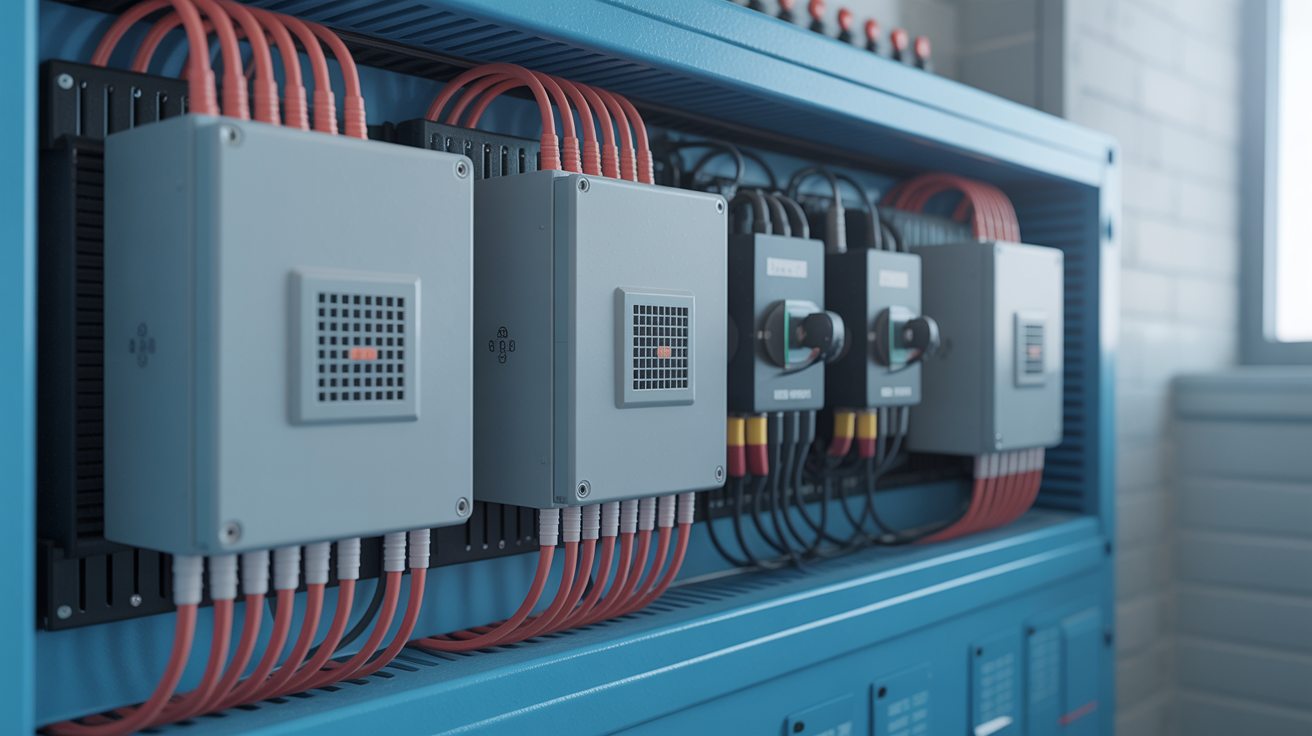
An APFC panel is built around four functional layers: sensing, control, switching, and capacitance.
Current and voltage sensing is done by current transformers (CTs) and voltage taps connected to the power factor relay (also called a PF controller or VAR controller). The CT typically clamps around one phase of the incoming supply and feeds a scaled current signal to the relay. The relay measures the phase angle between voltage and current and computes the displacement power factor continuously.
The PF relay is the brain of the panel. It compares the measured PF against a programmed target and a deadband (commonly ±0.02). When PF drifts below target, the relay sends a switching signal to add capacitance. When the load drops and PF approaches unity or goes leading, the relay switches stages out. Most modern relays include a time delay of 30 to 90 seconds before each switching event to prevent rapid cycling, which would damage contactors and capacitors.
Capacitor bank contactors are the switching elements. Each capacitor stage has a dedicated AC contactor or, in higher-end panels, a thyristor switch for transient-free switching. Standard contactors are cheaper; thyristor modules cost more but eliminate the inrush transients that gradually degrade capacitors. Thyristors accomplish this through zero-cross operation: because a thyristor only conducts when triggered and switches off automatically as the current waveform crosses zero, a stage can be brought online exactly when the capacitor voltage and the line voltage match, avoiding the current spike a mechanical contactor produces when it closes at a random point on the waveform (more on thyristor switching behavior).
Capacitor stages are the reactive power reserves. A typical industrial panel might contain four to twelve stages, each rated in kVAR. The capacitors themselves store energy in an electric field between their plates rather than a magnetic field, which is why they supply rather than absorb reactive power (capacitor energy storage basics) — that electric-field charge and discharge cycle, repeated thousands of times over a service life, is what eventually stresses the dielectric and shortens the capacitor's life.
How the PF Relay Switches Stages
The relay cycles through stages using a prioritized or rotational switching algorithm. Rotational switching is common: the stage that has been energized the longest is the first to be switched off, spreading wear evenly across all capacitors and contactors.
The sequence runs like this:
- Relay reads PF from the CT/VT inputs.
- PF falls below the lower deadband limit (e.g., 0.93 when target is 0.95).
- Relay waits out the programmed delay, then signals the next available contactor.
- The contactor closes, adding one stage of capacitance to the bus.
- Relay re-reads PF. If still below target, it repeats after another delay.
- When PF reaches the upper deadband (e.g., 0.97), no further stages are added.
The reverse happens when load drops: measured PF rises toward leading, and the relay begins shedding stages in rotation.
Step Sizing: Binary vs. Equal Steps
The size of each stage determines how finely the panel can tune the reactive power output. Two approaches are common.
Equal steps divide total kVAR capacity into identical blocks. A 300 kVAR panel with six stages gives 50 kVAR per step. This is simple to design and maintain: every contactor and capacitor assembly is identical, which simplifies spares inventory.
Binary-weighted steps size stages as powers of two: 1x, 2x, 4x, 8x the base unit. A four-stage binary bank with a 25 kVAR base unit can produce any combination from 25 kVAR to 375 kVAR in 25 kVAR increments, delivering 15 distinct output levels rather than just four. The tradeoff is that the stages are no longer interchangeable, and the largest stage carries significantly more stress.
A small example of an equal-step configuration:
| Stage | Rating (kVAR) | Contactor | Cumulative kVAR |
|---|---|---|---|
| 1 | 50 | K1 | 50 |
| 2 | 50 | K2 | 100 |
| 3 | 50 | K3 | 150 |
| 4 | 50 | K4 | 200 |
| 5 | 50 | K5 | 250 |
| 6 | 50 | K6 | 300 |
With this arrangement, the relay switches stages in pairs or individually to hold the facility at 0.95 PF regardless of which machines are running.
Why Automatic Beats Fixed for Variable Loads
A fixed capacitor bank is sized for one specific load condition. If the load drops significantly, the fixed bank can push PF into the leading range, which creates its own set of problems including voltage rise and potential relay trips. For more on that risk, see overcorrection and leading power factor risks.
APFC panels avoid overcorrection by continuously adjusting to whatever the load is doing. For a manufacturing plant that runs three shifts with different equipment on each, a fixed bank would overcorrect on the night shift (light load) and undercorrect during day-shift peak. The APFC panel adapts without any manual intervention.
There is also a financial case. Utilities assess power factor penalties when PF falls below a threshold, often 0.85 or 0.90, and that threshold is consistent with the industry-wide norm of roughly 0.9 to 0.95 that most tariffs use as the correction target (Wikipedia, power factor). A facility that drifts below threshold during heavy production hours faces penalty charges on every billing cycle. An APFC panel holds PF above the penalty threshold through load transitions that would otherwise drag it down.
For facilities with non-linear loads such as VFDs or rectifiers, detuned reactors and capacitor protection are worth reviewing before specifying an APFC panel, since harmonics can overload standard power factor capacitors.
Worked Example: Staging a 300 kVAR Bank
Consider a light manufacturing plant with a peak demand of 800 kW, a baseline PF of 0.82 lagging, and a utility penalty threshold of 0.90.
From the reactive power formula Q = P x tan(arccos(PF)), the plant at 800 kW and 0.82 PF draws about 342 kVAR of reactive power. To reach 0.95 PF, the required reactive power drops to roughly 263 kVAR, meaning the plant needs to supply about 79 kVAR locally. At half-load (400 kW), the reactive demand roughly halves too, to about 171 kVAR at the same 0.82 baseline PF, so the correction requirement scales down proportionally to around 40 kVAR.
A 300 kVAR APFC panel with six equal 50 kVAR stages covers the full range with margin for future load growth. At peak, the relay holds two stages energized (100 kVAR, comfortably above the 79 kVAR requirement). At night with reduced production, it might run with one stage or none. The relay handles the transitions automatically, staying within the 0.95 to 0.97 PF band throughout. For the full sizing methodology, see sizing power factor correction capacitors.
Undersizing the panel is a common mistake: a plant that only sizes for today's peak load has no headroom when a new production line is added. A rule of thumb used by many panel designers is to size for 15 to 20 percent above the calculated correction requirement at nameplate capacity, which is why the 300 kVAR bank in this example carries meaningfully more capacity than the bare 79 kVAR minimum.
Common APFC Panel Problems
Most nuisance calls on a commissioned panel trace back to a small set of causes:
| Symptom | Likely Cause | Typical Fix |
|---|---|---|
| PF reading stuck low despite stages energized | Wrong CT ratio entered into the relay | Re-check CT nameplate ratio against relay configuration |
| Rapid stage cycling ("hunting") | Switching delay set too short, or deadband too tight | Increase delay to 60 to 90 seconds; widen deadband to ±0.02 or more |
| One stage runs hot or fails early | Rotational algorithm not enabled, so one contactor carries most duty | Enable rotation; inspect that stage's capacitor for bulging |
| PF swings between lag and lead | Bank oversized relative to current load, or a stage stuck closed | Verify contactor operation; consider adding smaller trim stages |
| Nuisance trips on startup | Inrush transient from standard contactors closing off-wave | Specify thyristor-switched stages for that duty, or add pre-insertion resistors |
Installation Considerations
APFC panels involve live medium-current connections, capacitor discharge voltages, and coordination with upstream protection. Installation and commissioning should be handled by a qualified electrician or electrical engineer. Incorrect CT ratio entry into the relay, for example, causes the relay to misread PF by a constant factor and over- or undercompensate persistently.
During commissioning, verify that the CT ratio matches the relay setting, that each stage fires in sequence without visible arcing, and that the relay's switching delay is long enough to prevent hunting (rapid on-off cycling). Because capacitors retain a discharge voltage after de-energization, panels include discharge resistors sized to bring residual voltage down to a safe level within a specified time, typically under one minute; never assume a capacitor bank is safe to touch just because the contactor is open.
Frequently Asked Questions
What is the difference between an APFC panel and a fixed capacitor bank?
A fixed capacitor bank applies a constant amount of reactive power regardless of load. An APFC panel measures the actual power factor continuously and switches capacitor stages in or out to maintain a target PF. Fixed banks work when load is predictable and constant; APFC panels are necessary when load varies significantly across shifts or operating conditions.
How many stages should an APFC panel have?
More stages allow finer control of reactive power output but add cost and complexity. Four to eight equal stages cover most industrial applications. Facilities with highly variable or fast-changing loads sometimes use twelve or more stages, or combine standard contactors with a smaller thyristor-switched stage for fine trimming.
Can an APFC panel correct for harmonic-distorted loads?
Standard APFC panels address displacement power factor caused by inductive loads. They do not correct harmonic distortion. In fact, capacitors can resonate with supply inductance at harmonic frequencies, amplifying distortion rather than reducing it. Facilities with significant harmonic loads need detuned reactors in series with each capacitor stage or active harmonic filters alongside the APFC panel. The synchronous condensers vs. capacitor banks article covers alternative approaches for complex load profiles.
How long do capacitors in an APFC panel last?
Standard film capacitors rated for power factor correction typically have a design life of 80,000 to 100,000 hours at rated voltage and temperature. Switching transients, overvoltage, and operating above rated temperature all shorten life. Rotational switching algorithms help by distributing duty cycles across all stages rather than wearing out the first stage disproportionately. Annual inspection of capacitor housings for bulging or leakage is standard maintenance practice.
Is a thyristor-switched panel worth the extra cost over a standard contactor panel?
It depends on how often the load fluctuates. A facility where PF swings frequently, such as one with welding equipment or crane duty, can put a contactor-switched bank through many switching cycles per hour, and each cycle carries an inrush transient that ages the capacitors and contactor contacts. Thyristor stages eliminate that transient and tolerate far more switching cycles, which often pays back the added cost within a few years on high-cycling loads. For stable, slow-changing loads, standard contactors are usually the more economical choice.
What size fuse or breaker protects each capacitor stage?
Capacitor branch circuits are typically protected at 135 to 150 percent of the stage's rated current, per common practice for capacitive loads, since capacitors draw a higher inrush and can carry some harmonic current above their fundamental rating. The exact figure depends on the applicable electrical code and the capacitor manufacturer's guidance, and should be confirmed by the installing electrician rather than assumed from a rule of thumb.