Detuned Reactors and Capacitor Bank Protection
Capacitor banks installed for power factor correction can fail prematurely in facilities with significant harmonic distortion. The root cause is usually resonance: the capacitors and the supply inductance form a parallel resonant circuit, and if that resonant frequency lands near a characteristic harmonic, current amplification can reach destructive levels. Detuned reactors solve this by shifting the resonant point away from the harmonics before they cause damage.
At a Glance
- Resonance happens when capacitive and inductive reactance become equal at some frequency, and Wikipedia's summary of the effect confirms the classic result: "at resonance, the series impedance of the LC circuit is at a minimum and the parallel impedance is at maximum" (Wikipedia, electrical resonance).
- A detuned reactor is an inductor wired in series with the capacitor bank to push that resonant point below the lowest harmonic present, usually the 5th (250/300 Hz).
- A 7 percent tuning factor is the default choice for 6-pulse VFD and rectifier loads; 14 percent is used when 3rd harmonic content is present.
- VFDs, rectifiers, and other nonlinear loads are the usual harmonic source; Wikipedia's harmonics article lists them explicitly among "battery chargers, electronic ballasts, variable frequency drives, and switching mode power supplies" (Wikipedia, harmonics).
- A complete capacitor bank protection scheme also needs fuses, overvoltage protection, unbalance detection, and thermal protection on the reactor itself.
- Industry practice targets at least a 15 percent frequency margin between the series resonant point and the nearest characteristic harmonic.
How Harmonic Resonance Damages Capacitors
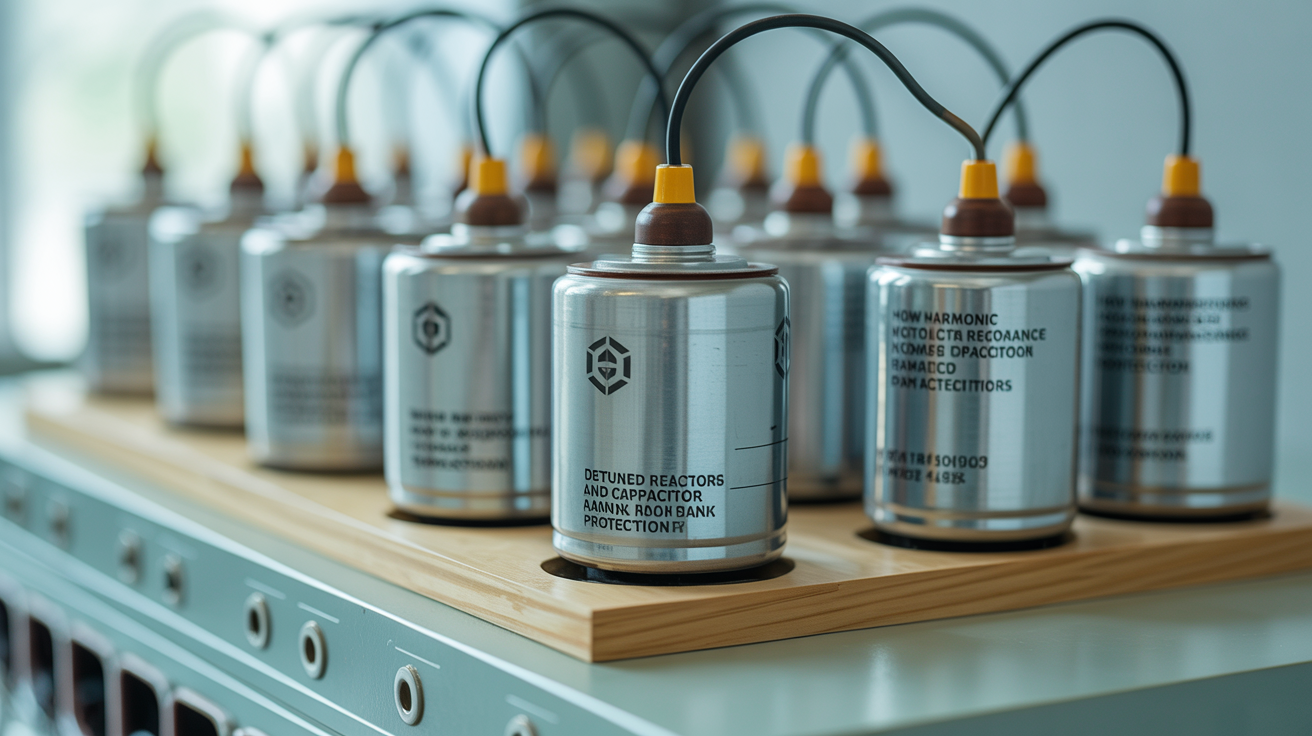
A capacitor bank looks capacitive at the fundamental (50 or 60 Hz), but as frequency rises, capacitive reactance falls while inductive reactance rises. That inverse relationship is a basic property of reactance: "capacitive reactance is inversely proportional to the signal frequency and the capacitance," while "inductive reactance is proportional to the sinusoidal signal frequency and the inductance" (Wikipedia, electrical reactance). At the frequency where these two reactances are equal, parallel resonance occurs and harmonic currents circulating in the loop can be many times the source harmonic level.
For a typical 6-pulse variable frequency drive, the dominant harmonics are the 5th and 7th (250/350 Hz on a 50 Hz system, or 300/420 Hz on 60 Hz). If the natural resonant frequency of the distribution system plus the capacitor bank happens to fall at 250 Hz, even a modest 5th harmonic source can push 300 percent or more of rated current through the capacitors. That overcurrent causes dielectric heating, accelerated aging, and eventually catastrophic failure of the capacitor elements.
This is why simply adding capacitors without accounting for the existing harmonic environment is a gamble. Facilities with harmonics-generating loads like VFDs need to assess resonance risk before energizing any new bank.
What a Detuned Reactor Does
A detuned reactor (also called a harmonic filter reactor or series reactor) is an inductor connected in series with the capacitor bank. Together, the reactor and capacitor form a series LC circuit with a resonant frequency lower than the natural parallel resonance of the system. The goal is to place that series resonant frequency below the lowest characteristic harmonic present on the system. This is the same LC resonance principle behind tuned filters generally: a series inductor and capacitor combination has a single resonant frequency where reactances cancel, given by the standard relation ω = 1/√(LC), or equivalently f = 1/(2π√(LC)) (Wikipedia, electrical resonance).
At frequencies above the series resonant point, the reactor-capacitor combination appears inductive to the network. An inductive impedance means the combination no longer amplifies harmonic currents the way a bare capacitor bank does. The system resonance is pushed below the 5th harmonic, out of the range where it can interact destructively.
The degree of detuning is expressed as a tuning factor, also called p-factor:
p = (X_L / X_C) x 100%
where X_L is the reactor's inductive reactance and X_C is the capacitor's capacitive reactance, both at the fundamental frequency. The series resonant frequency of the detuned bank is then:
f_r = f_1 / sqrt(p)
where f_1 is the fundamental frequency and p is expressed as a decimal.
Common Tuning Factors and Their Applications
Two tuning factors dominate real installations:
| Tuning Factor (p) | Series Resonant Frequency (50 Hz) | Series Resonant Frequency (60 Hz) | Typical Use Case |
|---|---|---|---|
| 7% (0.07) | 189 Hz (3.78th harmonic) | 227 Hz (3.78th) | Systems with 5th harmonic dominant |
| 14% (0.14) | 134 Hz (2.68th harmonic) | 160 Hz (2.68th) | Systems with 3rd harmonic present |
| 5.67% (0.0567) | 210 Hz (4.2th harmonic) | 252 Hz (4.2th) | Less common; tighter margin to 5th |
The 7% reactor is by far the most common choice in industrial facilities with 6-pulse rectifier loads. It places the resonant frequency at roughly the 3.8th harmonic, well below the 5th, while still delivering a meaningful capacitive reactance at 50/60 Hz for power factor correction.
The 14% reactor is chosen when there is measurable 3rd harmonic content, often in facilities with single-phase loads, unbalanced systems, or certain drive topologies. Pushing resonance below the 3rd harmonic requires more inductance, which means slightly more fundamental-frequency voltage drop across the reactor and a small reduction in the effective reactive power delivered by the bank.
Worked Example: Selecting a Detuning Percentage
A 400 V, 50 Hz facility has 200 kvar of capacitor banks planned. A power quality survey shows 5th harmonic voltage at 4.2 percent and 7th at 2.8 percent. No 3rd harmonic is detectable above noise. The task is to select an appropriate tuning factor.
Because there is no 3rd harmonic concern and the dominant disturbance is the 5th (250 Hz), a 7% reactor is appropriate.
Check the series resonant frequency:
f_r = 50 / sqrt(0.07) = 50 / 0.2646 = 189 Hz
The 5th harmonic sits at 250 Hz. The series resonant point at 189 Hz is well below that, so the bank presents an inductive character to the 5th harmonic. Harmonic amplification is avoided. The margin between 189 Hz and 250 Hz works out to about 24 percent, comfortably above the 15 percent minimum most designers target.
The reactor's inductive reactance at 50 Hz:
X_L = 0.07 x X_C
For a 200 kvar bank at 400 V: X_C = V^2 / Q = 160,000 / 200,000 = 0.8 ohm per phase (three-phase delta equivalent; actual per-phase values depend on the bank connection). X_L = 0.07 x 0.8 = 0.056 ohm per phase.
The reactor introduces a small additional voltage drop and reduces the net reactive power output slightly, but the effect is minor at 7 percent. For accurate compensation, the capacitor size is sometimes bumped up by roughly the tuning factor percentage to compensate. In this example, a designer targeting a true 200 kvar delivered output after detuning would spec the capacitor cells around 207 to 214 kvar to absorb that reduction, then verify the as-built reactive output by measurement during commissioning.
Additional Capacitor Bank Protections
Detuning handles the resonance problem, but capacitor banks need a broader protection package. A complete scheme typically includes fuses, overvoltage protection, unbalance detection, and thermal protection, summarized here:
| Protection | ANSI Function | What It Catches | Consequence If Missing |
|---|---|---|---|
| Individual element fuses | — | A single capacitor cell failing short | Fault current cascades into adjacent cells |
| Overvoltage relay | 59 | Bus voltage swell above 110% of nominal | Accelerated dielectric stress, shortened life |
| Unbalance relay | 60 | One or more elements failing open | Undetected asymmetry leads to cascading failure |
| Thermal / overload protection | 49 | Reactor overheating from harmonic current | Insulation breakdown, fire risk |
Fuses
Individual capacitor element fuses (internal) or group fuses (external) interrupt fault current if a capacitor cell fails short. Internal fuses are preferred in modern banks because they isolate a failed element while the rest of the bank continues operating, rather than taking the whole group offline.
Overvoltage Protection
Capacitors are rated for a maximum continuous voltage, usually 110% of nominal. Voltage swells, tap changer interactions, or lightly loaded systems can push terminal voltage above this. Overvoltage relays (59 function) monitor bus voltage and trip the bank contactor before dielectric stress accumulates.
Unbalance Detection
Most medium-voltage banks use current or voltage unbalance relays. When one or more capacitor elements fail open, the phase balance shifts. An unbalance relay (60 function) detects this asymmetry early, before cascading failures develop. This is especially important because the reactive power output of a bank depends on all elements contributing equally.
Thermal Protection
The reactor itself generates heat due to I²R losses and core losses. Reactors for detuned banks must be sized for harmonic current, not just fundamental current, because even a small harmonic component causes disproportionate heating at higher frequencies. Reactor datasheets list a de-rating factor for THD levels; exceeding it shortens insulation life.
Detuned vs. Passive Filter
A detuned reactor protects the capacitor bank. A passive filter goes further: by tuning the series LC circuit exactly to a specific harmonic, it actively attenuates that harmonic throughout the network. Filters are more effective at reducing distortion, but they are also more sensitive to system changes. If the supply inductance shifts, the filter tuning drifts, and a filter tuned slightly above its target harmonic can drift toward it over time as system conditions change, re-creating some of the amplification risk it was meant to solve.
For most power factor correction applications, detuning is the right choice. For facilities that need to meet strict harmonic limits, passive filters or active solutions may be necessary alongside the bank. The decision overlaps with broader power factor correction strategy and the acceptable distortion level at the point of common coupling.
The distinction between displacement power factor and true power factor also matters here: capacitor banks improve displacement power factor, but in a harmonic-rich environment, true power factor improvement depends on what happens to the distortion component as well.
Frequently Asked Questions
Can a standard capacitor bank be retrofitted with a detuning reactor?
Yes, in most cases. The reactor is added in series with the existing bank. The main check is that the contactor and switchgear are rated for the slightly higher reactor-capacitor circuit inrush and for the continuous current including harmonic content. The bank's voltage rating must also account for the voltage drop appearing across the capacitor terminals, which is slightly higher than the supply voltage in a detuned circuit.
Why do detuned reactors sometimes feel warm to the touch?
Reactors carry harmonic currents that the network is pushing into the capacitor bank. Core losses scale with frequency, so even modest harmonic content causes meaningful additional heating. A reactor that runs noticeably hot under normal load conditions may be undersized for the actual harmonic environment, or the ambient temperature and ventilation may be inadequate. Always specify reactors with a defined THD tolerance.
What happens if the tuning factor is too low?
If the series resonant frequency ends up too close to the 5th harmonic, the impedance presented to that harmonic is low and some amplification can still occur. Industry practice is to maintain at least a 15% frequency margin between the series resonant frequency and the nearest characteristic harmonic. A 7% reactor at 189 Hz gives a margin of about 24% below 250 Hz, which is comfortable.
Are detuned reactors required by code?
No universal code mandates them, but several utility interconnection agreements and standards (IEC 60831, IEEE 18) require that capacitor banks not cause or worsen harmonic resonance conditions. In practice, facilities with high harmonic distortion will be expected by their utility to demonstrate that new capacitor banks will not create problems, and a detuned design is often the easiest way to satisfy that requirement.
Does a detuned reactor reduce the amount of power factor correction the bank provides?
Yes, slightly. Because the reactor adds inductive reactance in series with the capacitor, the net capacitive reactance the bank presents to the fundamental frequency is reduced by roughly the tuning factor percentage. A 7% detuned bank delivers about 7% less reactive power at the fundamental than the same capacitor cells would deliver undetuned, which is why designers oversize the capacitor cells slightly to hit the target correction after detuning, as shown in the worked example above.
How do I know if my facility even needs detuning, or if a plain capacitor bank is safe?
The determining factor is harmonic content, not capacitor bank size. A facility with only linear loads, resistive heating, incandescent or simple motor loads with no drives, has little harmonic current to resonate with, and a plain bank is usually fine. Any facility with VFDs, UPS systems, rectifier-based chargers, arc furnaces, or significant nonlinear electronic load should assume some harmonic content is present and budget for a power quality survey before specifying an undetuned bank. Installation should always be verified by a qualified electrician or power quality engineer rather than assumed safe from equipment type alone.