How to Read a Power Factor Meter
A power factor meter gives you a direct window into how efficiently your electrical system is using the power it draws. Unlike a voltmeter or ammeter, which measure a single quantity, a PF meter captures the relationship between voltage and current, expressed as a number between 0 and 1 (or 0% and 100%). Knowing how to read that number, and what it implies about your load, is the first step toward making good decisions about power quality.
At a Glance
- Analog PF meters use a center-zero needle scale (0.5 lag to unity to 0.5 lead); digital meters show a numeric value with an explicit LAG/LEAD label.
- The meter reads the cosine of the phase angle between voltage and current, sourced from current transformers (CTs) and voltage taps, not from an inline connection to the load.
- A CT clamps around the conductor and produces a scaled, proportional secondary current, which is exactly why a PF meter can be installed without interrupting power (Wikipedia, current transformer).
- 0.98 to 1.00 is excellent, 0.90 to 0.97 is generally penalty-free, and most utilities start applying surcharges somewhere in the 0.85 to 0.90 range (Wikipedia, power factor).
- A leading reading usually means a lightly loaded system with fixed capacitor banks still fully energized, not a fault by itself.
- Any work inside live metering panels, including CT and PT wiring, must be done by a qualified electrician using lockout/tagout and arc-flash PPE.
Analog vs. Digital Power Factor Meters
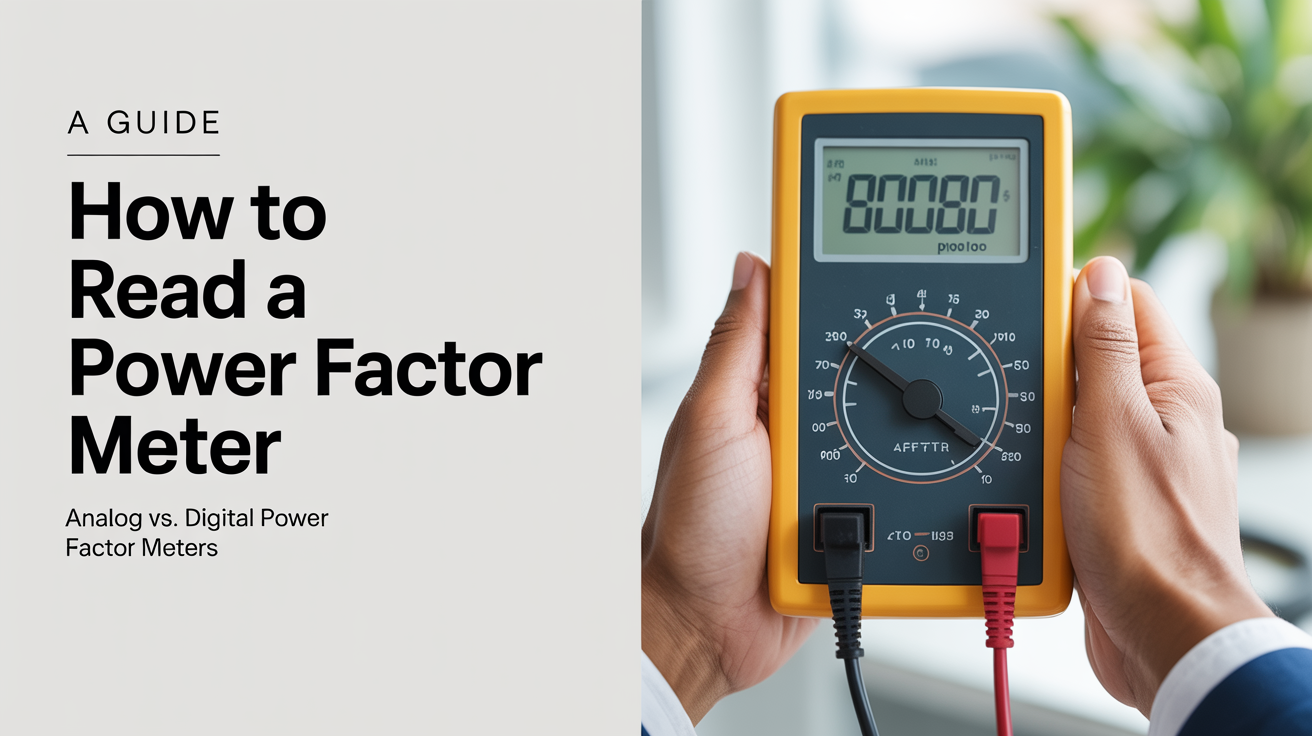
Older installations, particularly in industrial facilities built before the 1990s, often have analog (needle-type) PF meters mounted on switchgear panels. These meters have a center-zero scale that typically runs from 0.5 lag on the left, through 1.0 (unity) at the center, to 0.5 lead on the right. The needle physically deflects based on the phase angle between the incoming voltage and current signals wired to the meter.
Reading an analog meter correctly requires knowing where the needle is relative to unity. A needle sitting at the "0.8" mark on the lagging side means your load is drawing reactive current in addition to real current, putting it at 0.80 power factor lagging. The word "lagging" refers to the current waveform trailing behind the voltage waveform, which is the signature of inductive loads such as motors, transformers, and fluorescent ballasts.
Digital power factor meters (sometimes called power analyzers or power quality meters) display a numeric value on an LCD or LED screen, often with an explicit "LAG" or "LEAD" indicator alongside. Higher-end units also report kilowatts, kilovars, apparent power in kVA, and harmonics. Many panel-mount digital PF meters update several times per second and can log minimum, maximum, and average values over a set window, which is helpful when the load is variable.
One practical difference: analog meters tend to show an average reading because the needle mechanically damps rapid fluctuations, while a digital display can flicker noticeably on loads that cycle quickly (variable-speed drives, welding equipment). If the display is jumping around, switch to the average-hold function if one is available, or note the midpoint of the range you observe. Some digital meters also let you set an integration period, commonly 15 minutes to match utility demand-interval billing, which smooths out short transients and gives a reading that lines up with how the utility actually measures your billed power factor.
Where a PF Meter Sits in a Panel
A PF meter is wired in conjunction with current transformers (CTs) on the phase conductors and directly to the voltage busbars. It does not sit inline with the load current; the CTs clamp around the conductors and produce a scaled-down signal proportional to the actual current. Wikipedia's description of current transformers confirms this design: a CT "produces a current in its secondary which is proportional to the current in its primary," and window-type or split-core versions let cables run through the core, or even be clamped on without disconnecting them, for exactly this kind of non-interrupting measurement (Wikipedia, current transformer). This means a PF meter can be added or replaced without interrupting power to the load, though the CT secondary circuits themselves must be handled carefully, since an open-circuited CT secondary under load can develop dangerously high voltage.
In a typical industrial metering section, you will find the PF meter alongside an ammeter and voltmeter, all sharing the same CT and PT (potential transformer) inputs. The PF meter processes the phase angle between the PT output and the CT output to derive the cosine of that angle, which is the power factor. Revenue-grade CTs of the same type also drive the utility's own billing meter on many commercial and industrial services, which is one reason a facility's self-read PF meter and the utility's billed power factor usually track closely, assuming both are properly calibrated and using comparable averaging windows.
Working inside live switchgear and metering panels carries serious shock and arc-flash hazards. Any installation or rewiring of CTs, PTs, or meter connections must be performed by a qualified electrician following proper lockout/tagout procedures and arc-flash PPE requirements.
Interpreting a Reading: What the Numbers Mean
The number on a PF meter is the cosine of the phase angle between voltage and current. A reading of 1.00 means the two waveforms are perfectly in phase; all apparent power is doing real work. A reading of 0.00 (which almost never occurs in practice) would mean the load draws purely reactive current with no real power consumed at all. This tracks the standard definitions of active, reactive, and apparent power: active power is the power that "results in net transfer of energy," while reactive power "oscillates between the source and load" without doing useful work (Wikipedia, AC power), and the ratio between them, viewed as a phase relationship, is exactly what a PF meter displays.
Here is a quick reference for common readings:
| PF Reading | Lag/Lead | What it typically means |
|---|---|---|
| 0.98 to 1.00 | Unity | Excellent; minimal reactive demand |
| 0.90 to 0.97 | Lag | Good; most utilities accept this without penalty |
| 0.80 to 0.89 | Lag | Marginal; check your utility's threshold |
| 0.70 to 0.79 | Lag | Poor; reactive charges likely; correction worth evaluating |
| Below 0.70 | Lag | Very poor; significant reactive burden; correction usually justified |
| Any value | Lead | Capacitive load or over-corrected system; check for excess capacitor banks |
A lagging reading is far more common in facilities with lots of motor loads. A leading reading can appear in lightly loaded systems that have fixed capacitor banks installed for power factor correction, or in buildings with long cable runs and light inductive loads, where the cable capacitance dominates.
For more on the difference between these two conditions, see the article on leading vs lagging power factor.
What kW, kVA, and kVAR Look Like on the Same Reading
A PF number alone tells you the ratio, but the underlying magnitudes matter for deciding what to do about it. The table below shows how the same 100 kW real load looks at different power factors, all drawn from the identity kVA = kW / PF:
| Power Factor | Apparent Power (kVA) | Reactive Power (kVAR) | Extra Current vs. Unity PF |
|---|---|---|---|
| 1.00 | 100 | 0 | 0% |
| 0.95 | 105 | 33 | 5% |
| 0.90 | 111 | 48 | 11% |
| 0.80 | 125 | 75 | 25% |
| 0.70 | 143 | 102 | 43% |
| 0.60 | 167 | 133 | 67% |
A facility running 100 kW of real load at 0.70 PF is pulling 143 kVA from the utility and paying for the capacity to deliver that much, even though only 100 kW is doing useful work. That gap is what correction equipment closes.
Lag vs. Lead: Reading the Indicator
On an analog meter, the "lag" and "lead" zones are printed on the face. The needle swings left toward "lag" when current lags voltage, and right toward "lead" when current leads voltage. A needle stuck hard against the left stop typically means a very inductive load or an open-circuit CT secondary, which is a fault condition requiring immediate attention.
Digital meters display LAG or LEAD as a text label. Some older digital units use the sign convention of the reactive power (Q) instead: positive Q means lagging (inductive), negative Q means leading (capacitive). If your meter shows kVAR with a sign, check the manual to confirm the convention before drawing conclusions.
When the reading is very close to unity (say, 0.99 LAG or 0.99 LEAD), the lag/lead label may switch back and forth if the load fluctuates slightly. This is normal and is not a sign of meter malfunction.
Using the Reading to Decide on Correction
A PF meter reading tells you the current state of your system. The practical question is what to do with that information.
Most utility tariffs impose a reactive demand penalty or a low-power-factor surcharge once the measured PF drops below a threshold, commonly 0.85 or 0.90, consistent with the general industry range of roughly 0.9 to 0.95 that most references cite as the point where utilities begin charging commercial customers extra (Wikipedia, power factor). If your meter consistently shows values below that threshold during peak demand hours, adding capacitor banks for power factor correction will reduce the reactive component and bring the reading up toward unity.
Before sizing any correction, you need more than the PF meter alone. You also need the real power (kW) and apparent power (kVA) so you can calculate the reactive power (kVAR) that needs to be offset. That calculation is covered in detail in calculating power factor from watts and VA.
A few things to watch for when monitoring the meter over time:
- Gradual decline over weeks or months often points to additional motor loads being added without corresponding capacitor bank updates.
- Sudden drop to a very low value can indicate a capacitor bank failure or a new large inductive load coming online.
- PF swinging between lag and lead on a system with fixed capacitors suggests the bank is oversized for the current load level, which can cause voltage rise and stress equipment.
- A reading that never changes at all, even as production visibly ramps up and down, can mean the meter is stuck or the CT secondary has failed open; cross-check against the utility bill's reported power factor if one is provided.
For installations where you need to measure PF without a panel-mounted meter, a clamp meter with power measurement capability is a practical field tool. The process for that approach is explained in measuring power factor with a clamp meter.
Frequently asked questions
What does a PF reading of 0.85 lag mean in practice?
It means that for every 1 kVA of apparent power your system draws from the utility, only 0.85 kW is being converted into useful work. The remaining portion circulates as reactive power. On a 100 kVA load, you would be using 85 kW of real power and drawing roughly 53 kVAR of reactive power. Many utilities start applying surcharges at or below this level.
Can a power factor meter read above 1.0?
No. Power factor is bounded between 0 and 1 by definition, because it is the cosine of a phase angle. If a meter displays a value above 1.0, it is either malfunctioning or measuring total power factor that includes distortion (as some power quality analyzers do in a different measurement mode). Fundamental displacement power factor cannot exceed 1.0.
Do I need a special meter to measure power factor, or will a standard multimeter work?
A standard multimeter measures voltage, current, and resistance; it does not measure phase angle and cannot give you power factor directly. You need either a dedicated PF meter, a clamp meter with power factor measurement built in, or a power quality analyzer. Some smart energy monitors installed at the main panel can also report PF continuously.
How often should I check the power factor meter readings?
On a stable facility with fixed loads, a monthly check is usually enough. In facilities with variable or seasonal loads (HVAC-heavy buildings, manufacturing plants with shifting production schedules), checking weekly or installing a data-logging power analyzer gives a more complete picture and helps catch problems before they show up on a utility bill.
Why does my panel meter show a different power factor than my utility bill?
The two numbers can legitimately differ because they are measured over different time windows. A panel meter often shows an instantaneous or short-averaged reading, while utility billing typically uses a monthly average or the average during a specific demand interval, often 15 or 30 minutes at peak. A facility that runs efficiently most of the month but has a rough patch during a few peak-demand windows can show a good instantaneous reading on the panel while still facing a penalty on the bill, because the utility's calculation is weighted toward the period that matters for billing.
Is it normal for the reading to change every time I check it?
Some fluctuation is normal on any facility with variable loads, since motors starting and stopping change the reactive demand in real time. What is not normal is a reading that swings wildly by 0.2 or more within seconds under otherwise steady conditions; that pattern usually points to a cycling load like a welder or intermittent motor rather than a meter problem, and is worth investigating with a data-logging meter set to record minimum and maximum values over a shift.